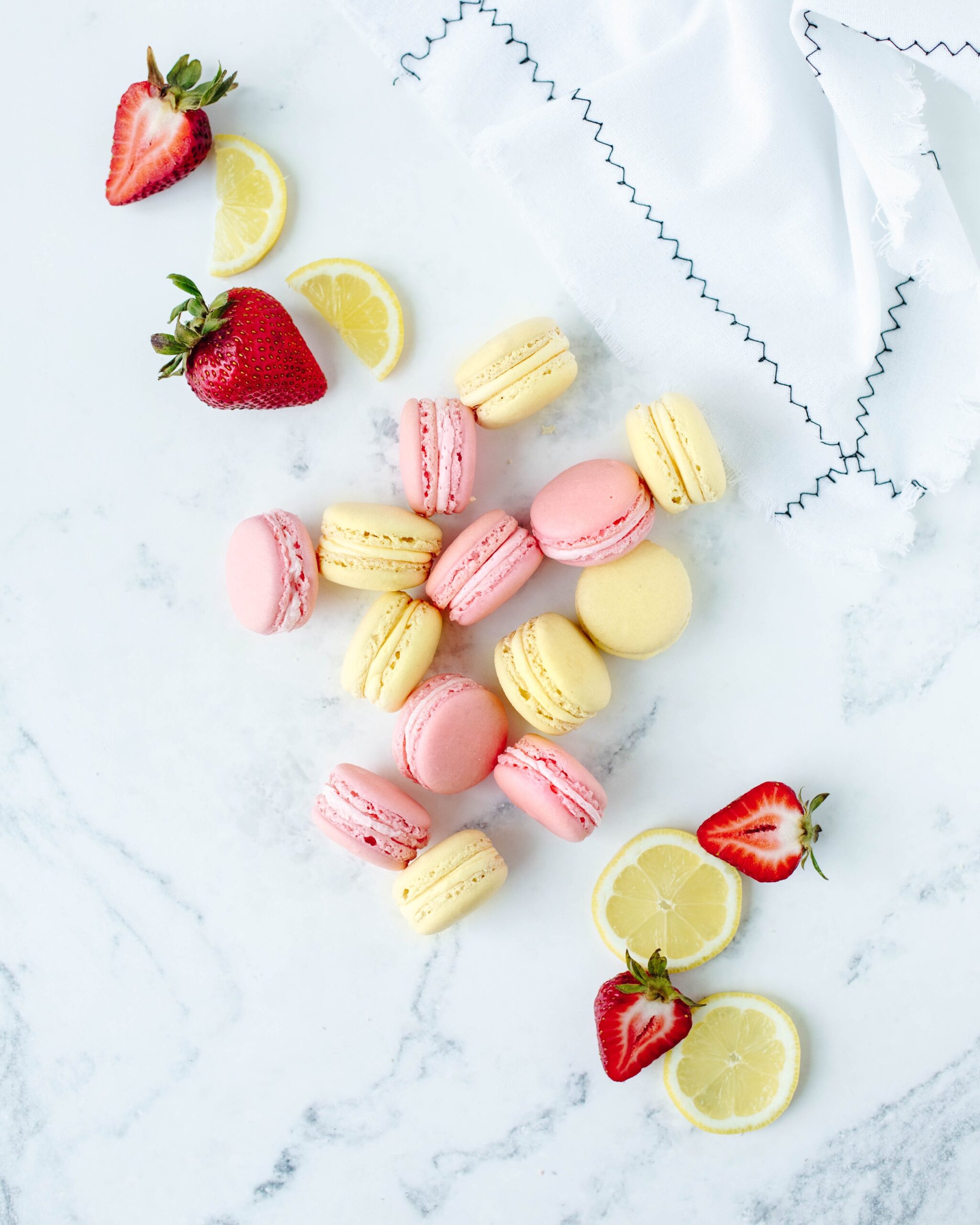
Ingredients
Method
Step 1: Prep the dry ingredients
- Measure all ingredients before starting.
- Combine the powdered sugar and almond flour, then pulse in a food processor until fine and lump-free. For best texture, sift the mixture after blending. Set aside.
Step 2: Split the egg whites
- Divide the egg whites into two equal portions (72 g each).
- Add one portion to the almond flour–powdered sugar mixture and mix with a spatula until a thick paste forms.
- If coloring your macarons, add gel food coloring at this stage.
Step 3: Prep the mixing bowl
- In a separate bowl (preferably a stand mixer bowl), wipe the inside with a paper towel lightly dampened with lemon juice to remove any fat residue.
- Add the remaining 72 g egg whites to the bowl and set aside.
Step 4: Make the sugar syrup
- In a small saucepan, combine the granulated sugar and water. Stir briefly, then heat over medium-low until the mixture reaches 244°F (118°C) on a candy thermometer.
- No thermometer?
- Drop a small amount of syrup into cold water—it should form a soft, moldable “raindrop” shape.
Step 5: Make the Italian meringue
- Once the syrup reaches temperature, immediately begin pouring it slowly down the side of the mixing bowl into the egg whites while whipping.
- Do not pour directly into the whisk.
- Important: Start pouring as soon as the syrup is ready—if it thickens too much, it will not incorporate properly.
Step 6: Finish the meringue
- Continue whipping on medium-high speed for about 45 seconds, until the meringue is glossy, fluffy, and holds stiff peaks.
- Add vanilla (or desired extract) and mix briefly to combine.
Step 7: Macaronage (combine batter)
- Add a small portion (about 1 cup) of the meringue to the almond paste to loosen it.
- Then gently fold in the remaining meringue using a spatula.
- Use the figure-8 test to check consistency: the batter should flow smoothly and form a full “8” without breaking. Stop folding just before this point—overmixing is harder to fix than undermixing.
Step 8: Prepare piping
- Fit a piping bag with a medium or large round tip.
- Place the bag over a cup and fill with batter for easy transfer.
Step 9: Pipe the shells
- Pipe macarons onto parchment-lined baking sheets.
- For even sizing, use a silicone macaron mat or count consistently while piping (ex: “1-2-3” per shell).
Step 10: Remove air bubbles
- Tap the baking trays firmly on the counter 4–6 times to release air bubbles.
- Pop any visible bubbles with a toothpick.
- If needed, slide the parchment onto the counter to reuse trays (this recipe yields about 2½ trays).
Step 11: Rest the shells
- Let shells rest uncovered for at least 30 minutes, or until the tops are dry to the touch and you can gently glide a finger over them without sticking.
Step 12: Bake
- Preheat oven to 300°F (convection).
- Bake macarons for 17 minutes.
- Let rest on the tray for at least 5 minutes, then slide the parchment onto the counter to cool further.
Step 13: Make the frosting
- Beat butter and shortening together until light and off-white.
- Gradually add powdered sugar until fully incorporated.
- Add heavy cream and extracts, then whip until fluffy.
- Optional: fold gently with a spatula to remove excess air bubbles before piping.
- Transfer frosting to a piping bag or use a knife for filling.
Step 14: Fill & mature
- Pair similar-sized shells and fill with buttercream or soft caramel.
- Macarons are best after 12–24 hours, once the filling and shells have time to set together.
- Store in the refrigerator for up to 10 days, or at room temperature for up to 8 days.